
Vol 3, Issue 14. Quarter 3 – 2026.
Let’s restate the idea from the title in a different way. If you truly understand something you don’t need complex tools to explain it. The contrapositive of that statement is that if you do need complex tools to explain it, then you really don’t understand it. Here is a clever example.
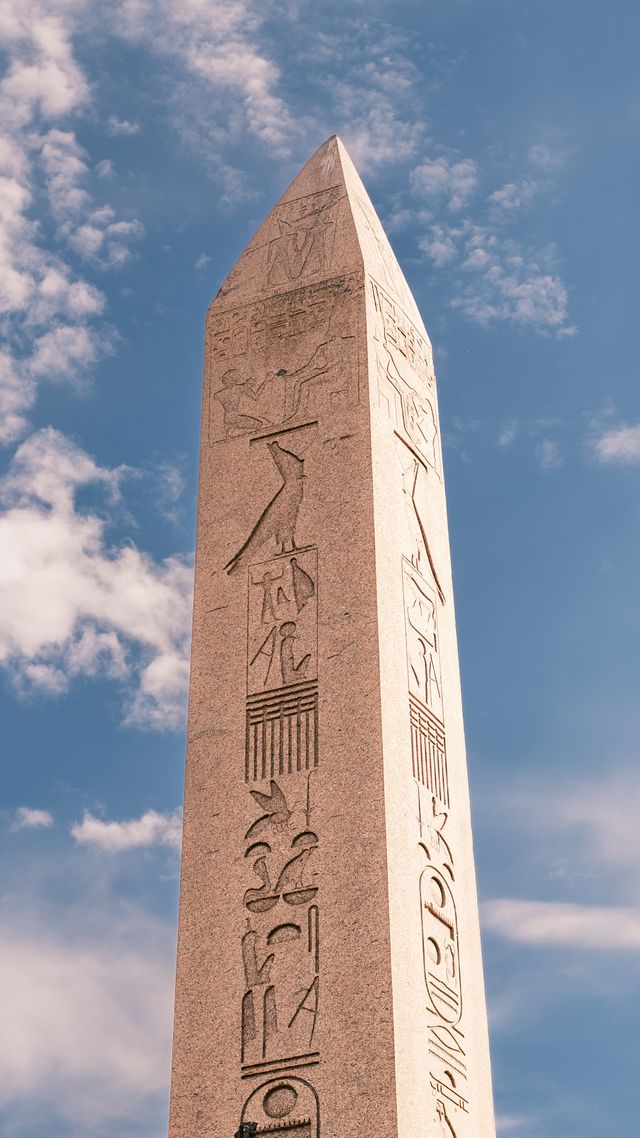
In the middle kingdom in Egypt a Pharoah had two obelisks of the exact same size and shape carved out of one piece of stone. Obviously, this means that the two obelisks have the same height. One of these obelisks was placed at a temple in the Northern kingdom, and the other was place at a temple in the Southern kingdom about 400 miles away. It turns out that the line connecting them runs roughly from North to South. Some Priests who had been to both locations noticed that the sun seemed to be at a slightly different angle in the North, as compared to the South. This seems hard to prove if you cannot be at two places at the same time and you cannot simply call someone at the other location and ask them about the angle to the sun. A more clever approach was required to deal with the question.
There is also a little known fact from Civil Engineering that is relevant to this story. Over long periods of time, sand flows like incredibly slow-moving water. As a consequence of this, whenever something really heavy with a flat base is set on sand, it will become level, even if it was slightly unlevel to begin with.
Back to our main story. When the sun rises, the shadow of a tall structure like an obelisk will be extremely long. But as the sun rises in the sky the shadow becomes shorter and shorter. In fact, it will be shortest at what we now call high Noon on each day. After that it begins to get longer again as the sun sets. A rope can easily be stretched from the base of the obelisk to the end of its shadow. You can start at any time in the morning and then cut the rope until it reaches its shortest point. This moment in time will be the same, no matter where you stand when you do this. The rope that you end up with is the one that corresponds to the minimum distance. This was done over some number of days and the ropes were collected in a great library in the Northern kingdom. When scholars compared the ropes from the two locations they noticed that the ropes from the Southern temple were always shorter.
Here is where the story gets really interesting. When the Nile would flood each year, it would wipe out many of the property lines. Surveyors had to go out each year and redraw the lines so they could tell who owned what land. As a result, they became experts at geometry. A necessary part of that expertise was the ability to figure out the angles in a right triangle if they know a length and a height. For the two obelisks they knew the height exactly. Using the ropes, they know the length of the shadows exactly. From this they could figure out the angle of the sun to both obelisks at the exact same time. From this they figured out that the two angles to the sun differed by 6 degrees. Why would the angles be different if the angle between the earth and the obelisk is always 90 degrees? This cannot happen if the earth is flat. The only answer that made sense was that it wasn’t the obelisks that were different – the angle of the earth was. In other words, the earth was curved between these two points.
But wait, there’s more. The distance between the two points was about 400 miles and the difference in the angles was about 6 degrees. 360/6 is 60. In other words, 6 degrees is about 1/60 of the distance around a circle. From this it appeared that the earth was about 60 * 400 = 24,000 miles around. Just for fun, google the circumference of the earth and see what you find. If you don’t want to waste your time, I will simply tell you – its almost exactly 24,000 miles. So ancient Egyptians figured out that the earth was round and about 24,000 miles in circumference using nothing more than two pieces of rope.
Right about now you are probably thinking something like, “that’s cute Chester, but what the hell is the point?” Well here it is. If you really know what you are doing, you shouldn’t need something extremely complex to explain it. I should be able to show you the earth is round without using an airplane, or a satellite, or a 100 story tall building. In the same way, if I want to explain a great investment plan to you, I shouldn’t need AI, or pages of dense code, or even a complex spreadsheet to explain it to you. Five or six lines of text should do. For example,
- The time to invest is NOW. The amount to invest is the money that you do not need to live off of today.
- The correct share of equities in your portfolio is as much as you can stomach.
- The correct planning horizon (today) is the retirement of your grandchildren.
- Diversification is the only free lunch that we know of, and we want it at the lowest possible cost.
- Until I feel like I have a better model, that I can live with in any possible outcome, I am going to stick with this plan.
Please, don’t get this twisted. Just because I say something simple, doesn’t mean it’s right. But if someone needs a 100-page prospectus to explain their financial product to you, my advice is simple – RUN. When someone tells you, “I could explain my strategy, but it’s probably too complex for you to follow,” RUN. If the answer to every simple question feels like a 20-minute lecture – RUN. I repeat, I haven’t proven that I am right, but if the investment strategy that you are being sold is a lot more complex than what we show you here – well you can figure out what I think you should do from there.
0 Comments