
Vol 3, Issue 5. Quarter 2 – 2026.
Go to your favorite search engine and type in “Retirement Spending Rules”. After you scroll past all of the vendors explicitly trying to sell you some service, you will see entries about “The 4% Rule”, the “3.5% Rule”, “Guyton-Klinger Guardrails”, the “SAFEMAX” rule, “Permission to Spend Rules”. If that list wasn’t confusing enough, try this liston for size:
- The PAY Rule
- Bengen’s Constant Inflation-Adjusted Spending Strategy
- Fixed-Percentage Withdrawals
- Endowment Formulas for Retirement Spending
- Bengan’s Hard-Dolllar Floor-and-Ceiling Approach
- Vanguard’s Percentage Floor-and-Ceiling Approach
- Kitces’s Ratcheting Rule
- Zolt’s Glide Path Rule
I could do this all day, but I suspect you get the point by now. Every character who wants his 10 minutes of fame on Youtube will make a video with his/her/their favored rule with a cute name. With that as the backdrop, I am now going to unapologetically do the exact same thing with a very small twist.
I have actually looked at a collection of these rules in a fairly rigorous way. You can see some of that work in the documents Library on our site at https://chesterchambersphd.com/document-library. If you want THE definitive text (in my opinion) on every rule worth considering look at this book by Wade Pfau on the subject (Pfau, 2017). If that is too much to do in one sitting, let me lay out what I REALLY do in one short list.
- I ask my wife what we spend each month
- I add 20% for the fun of it
- I enter that data into a planning package
- I look at the ”Probability of Success”
- I adjust as needed
What does adjust mean?
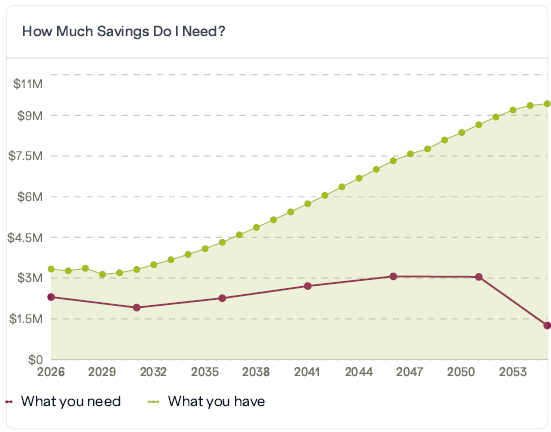
First let me give a shout-out to my preferred planning package here. I use a site named Boldin.com. (Please note: They pay me nothing, and I am selling nothing!!!) Their system allows me to input all of my data on assets, liabilities, planned spending, Social Security strategy, and tax strategy. This includes budgeted amounts for healthcare, housing, splurges in spending, long-term care, and a generous buffer for “general stupidity.”
With that behind us, let me talk about when and what I adjust. I look this plan over at the start of each quarter. I hold a figure in my mind for what our Net Worth figure should be at that point in time. This number will evolve over time due to changes in health status, outside opportunities, etc. I also check to see that once I build my plan the estimated probability of success does not fall below 95%. If the market went up enough to reduce that figure, I plan to do something silly like give money away, or torture myself by taking a trip that I never enjoy. If the market goes down enough to increase it, I adjust by eliminating things. Of course, the silly things get dropped first. It hasn’t happened yet, but when the day comes where that is not sufficient, I will work down my list of more serious possible adjustments. I have shown you this list before, but here is a condensed version for ease of reference.
Here is a list of 10 possible adjustments you can always consider:
- Use part of the money that is not in your retirement account to allow you to reduce your withdrawal from those accounts in years when the market goes down.
- Sell something that is not really that important anymore, like jewelry, an extra car, etcetera.
- Don’t take that big trip this year – look at the numbers next January and see if you can do it then.
- Don’t donate as much money this year as you did last year.
- Move to a smaller house.
- Figure out how to make money on that blog you started (Maybe I should consider that at some point!)
- Move to a state with a lower cost of living.
- Plant a garden to grow food that you used to buy.
- Figure out how to make something that you used to buy.
- Get over the fact that the account balance goes down over time. That’s what it is supposed to do because your planning horizon is shorter now than it was when you started.
Let me stress something that may be a bit of a surprise. The “Software” portion of this exercise is actually critical. I know that “Do-It-Yourself” is a bit part of our message, but you need a platform that captures the nuances of tax planning, determining the sequence of accounts to draw from, changes to the plan when you start or stop some endeavor that generates cash, IRMAA rules, changes in health status, etc. Yes, I can do all of this in spreadsheets – but Why? I am never going to keep up with all of the IRS rule changes, those rules will change after the next election, and we all know that the Social Security rules are going to change in the coming years as well. Let someone else keep track of all of that, and show me how it plays out in my plan. I can handle the rest.
Here is the part that I suspect will come as a surprise to absolutely no one. I do not concern myself with any arbitrary statement such as the “4% Rule.” I have a framework within which I operate. It is informed by what I know, read, find, etc. But it is NEVER overridden by anyone else’s statement of what “I am supposed to do” (whatever the hell that means.) I do what feels right to me – that’s the rule. Your opinion may be informative, or even entertaining – but it will never be “The Rule.”
I may provide updates on how this plays out in the coming months or years. Stay tuned as we walk with you through this process. That is exactly why we are here.
0 Comments