
Vol 3, Issue 12. Quarter 2 – 2026.
Imagine it’s 1950. You’re 65, your back is ruined from thirty years in a coal mine or a textile mill, and your “retirement plan” consists of a small Social Security check and the hope that your children have a spare bedroom. In 1950, nearly 35% of American seniors lived in poverty. The “Golden Years” weren’t golden; they were grey, precarious, and short.
Fast forward to 2026. If you listen to the mainstream media, you’d think we’re heading back to the soup lines. We are told daily that the “401(k) experiment” has failed, that Social Security is a “Ponzi scheme” on the brink of collapse, and that an entire generation is destined to eat cat food in their twilight years.
I’m here to tell you that the “Retirement Crisis” is the most successful marketing campaign of the 21st century. It sells clicks for media outlets and gets trillions of dollars in assets under management for financial advisors. But when you strip away the hysteria and look at the cold, hard math, the reality is startling: American retirees today are, by almost every objective measure, the most comfortable and financially secure generation in the history of the species.
The Death of Senior Poverty
Let’s start with some simple data that the crisis-mongers love to ignore. The single most important metric for societal success is the poverty rate among its most vulnerable. In 1960, the elderly poverty rate was roughly 35%. By 2024, properly measured, poverty among older adult citizens had plummeted to around 6%.
Why do I say “properly measured”? Because the “official” poverty measure is a relic of the 1960s that fails to account for a variety of benefits. The US Census Bureau created a newer measure recently that includes a variety of government transfers beyond Social Security. This is called the Supplemental Poverty Measure (SPM). Using this measure the poverty rate in the US is about 12.9% and the same measure for retirees is less than half of that. Discussions of Senior Poverty also typically ignore that fact that most seniors have paid off their largest expense—their mortgage. When you factor these items in the “crisis narrative” evaporates.
Furthermore, measured in inflation-adjusted dollars, the incomes of today’s seniors are at record highs relative to working-age Americans. We aren’t just doing “okay”; we are lapping the field. According to research from the American Enterprise Institute (AEI), American seniors have higher incomes relative to their working-age counterparts than seniors in almost any other developed nation in the world.
The Savings Gap Myth
Andrew Biggs, is a former Deputy Commissioner of the Social Security Administration. He argues that much of the misunderstanding stems from the fact that the way we calculate “retirement readiness” is fundamentally flawed.
The industry standard says you need to bring in 70% of your final salary to retire comfortably. But ask yourself this question, if I actually “lived” off of less than 70% of my income while working, why do I need that much now? For my household, 30% of my income goes to the mortgage company. The reason is simple – to get rid of the mortgage ASAP. After that is gone a 30% drop in income leaves me with the same amount of disposable funds. In addition consider this:
Lower Expenses: Retirees don’t pay FICA taxes, don’t need to save for retirement anymore, and their work-related expenses (commuting, professional wardrobes) vanish.
The Career Average vs. The Peak: Critics of the current system frequently point out that for most people Social Security benefits only replace 40% of earnings. But they are comparing that benefit to your highest earnings years. When Biggs calculates replacement rates relative to inflation-adjusted career-average earnings—the money you actually lived on for forty years—the replacement rate for the median household jumps to about 65% from Social Security alone.
When you add retirement account withdrawals and/or annuity payments to that 65% base, most retirees are living on more “disposable” cash than they ever had while they were working and raising a family.
How Can We Be Broke With More Money Then Ever?
The most common refrain in the “crisis” narrative is that the shift from Defined Benefit Plans like traditional pensions to Defined Contribution Plans like 401(k)s has left us stranded. The data says the exact opposite.
In the 1970s—the supposed “Golden Age” of pensions—only about 40% of private-sector workers had any kind of retirement plan at all, and most pension payments were very small. Today, between Social Security, IRAs, and 401(k)s, total retirement assets in the U.S. have tripled as a percentage of GDP since the 1980s. Let me say that a different way. The money set aside for retirement, adjusted for inflation, on a per capita basis is at least 3 times what it was 50 years ago. If it wasn’t a crisis then, and we have 3 times as much money now, then it’s not a crisis today.
Let’s also note that the vast majority of jobs today are simply less physically demanding. In 1950, a 68-year-old was often physically incapable of continuing to work in the factory. Today, the biggest “on-the-job risk” for many of your office-mates is carpal tunnel syndrome. This “health capital” allows for a flexibility in retirement timing that our grandfathers could only dream of. The “Retirement Crisis” is a no-show because the private system and Social Security are working hand-in-hand better than the narratives suggest.
Key Take-Aways: What Do You Learn From All of This?
Don’t let the “Crisis Industry” bully you into a state of perpetual anxiety. To own your plan with a clear conscience, remember these four key ideas:
- G – Gains are Relative: Your “replacement rate” matters less than your “disposable income.” With lower taxes, no mortgage, and zero retirement savings requirements, a 70% nominal income will feel like a 100% lifestyle.
- O – Outcomes Over Narratives: Senior poverty is at historic lows (6%), and senior incomes are at historic highs. The data says you are winning, even if the news says you are losing.
- L – Leverage Your Health: Today’s jobs are cognitively demanding but physically forgiving. The ability to work an extra two years is the single most powerful “hedge” in financial history.
- D – Data Over Drama: A slew of researchers has shown that total retirement assets have tripled relative to the size of the economy. The “401(k) experiment” didn’t fail; it created the largest pool of private wealth that the world has ever seen.
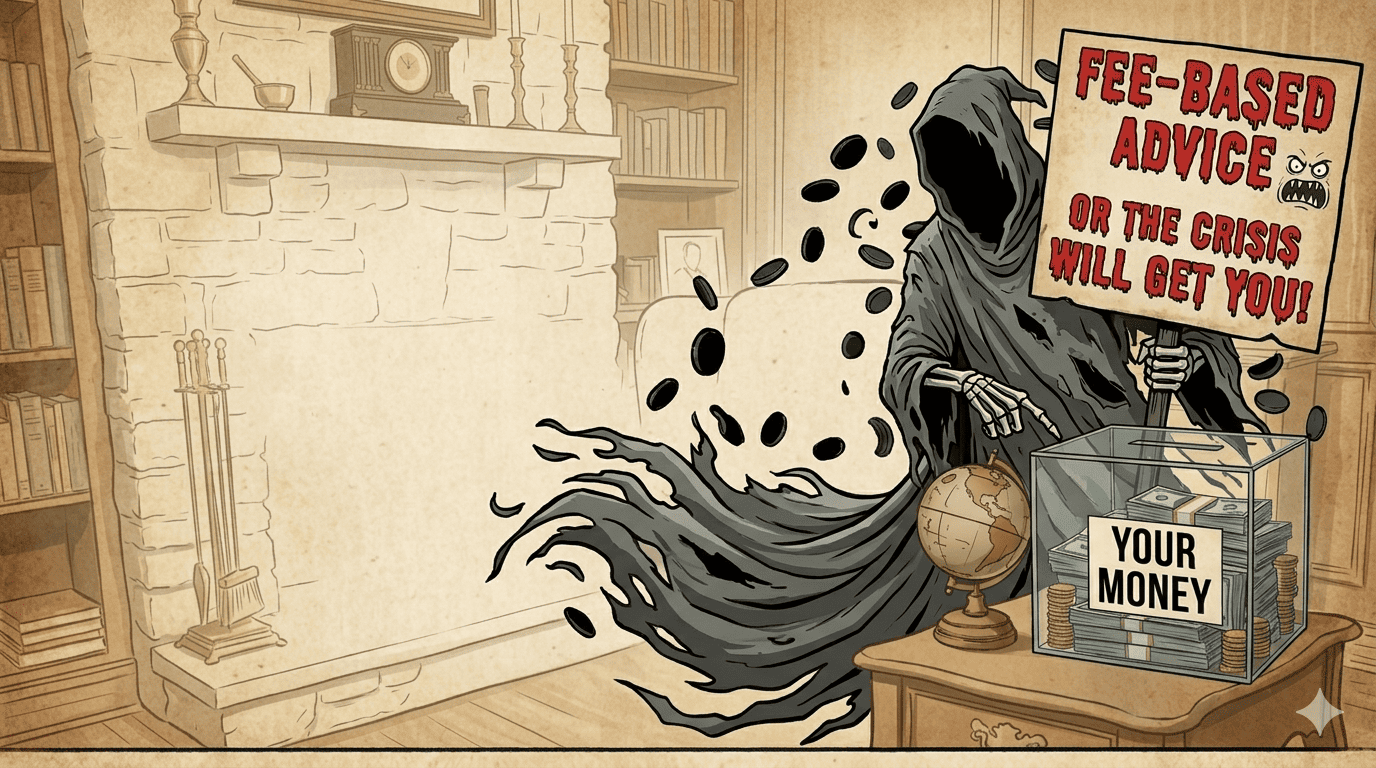
Here is the bottom line. Always beware of the fellow that shouts that there is a crisis and the only way out is to pay them a percentage of your assets to take care of it for you. I am not saying that they are lying. I am only saying that incentives work, and their incentive is to convince you that you need their help. I am here to call BS on that claim and to help you handle this yourself.
The “Retirement Crisis” is a fairy tale about the baba yaga told to those who don’t know how to look at the balance sheets. Our mission is to ensure you see the historic comfort of the 2026 retiree for what it is—a triumph of the American system, not a tragedy.
Stay with us. There is a lot more to come!!!
0 Comments